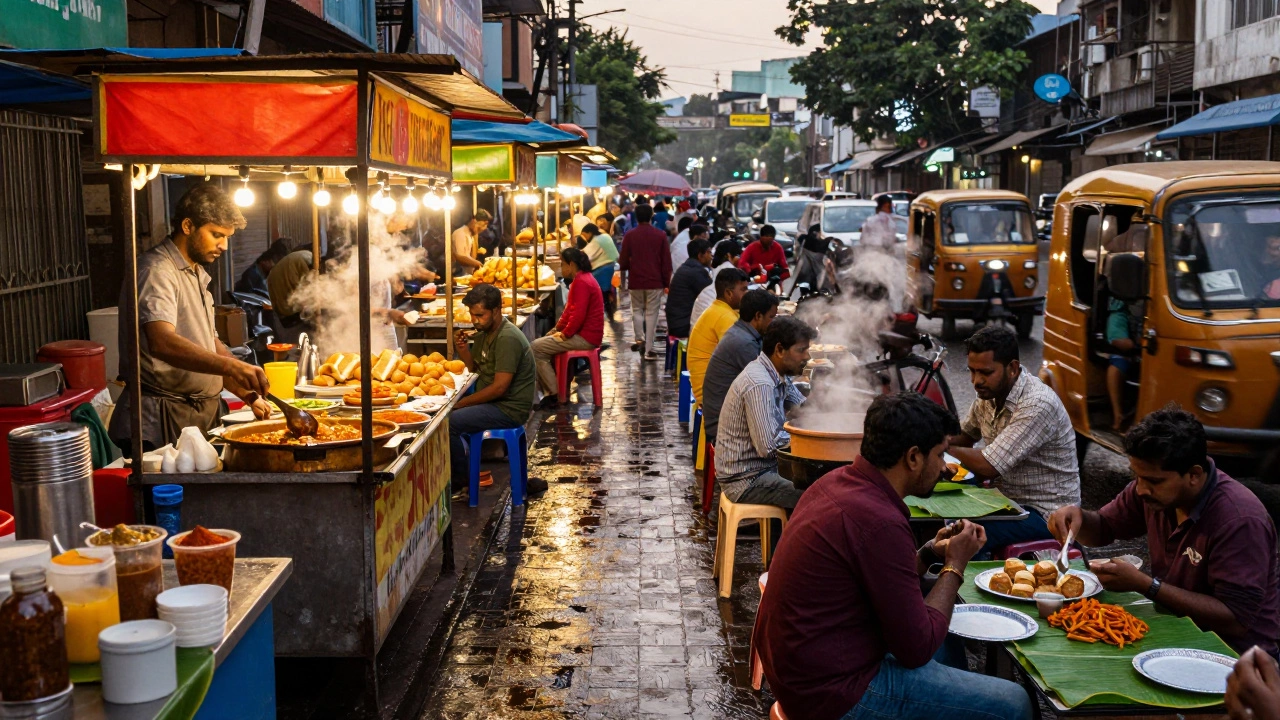
Ask anyone who’s eaten their way across India, and they’ll tell you: street food isn’t just a meal here-it’s a way of life. But if you’re wondering which city serves up the most street food, the answer isn’t just about quantity. It’s about variety, volume, cultural roots, and how deeply it’s woven into daily routines. The winner? Mumbai. Not because it’s the biggest city, but because its streets are alive with food stalls from dawn till midnight, serving over 5,000 different street food items daily across every neighborhood.
Mumbai: The Unofficial Street Food Capital
Mumbai doesn’t just have street food-it breathes it. From the crowded lanes of Dadar to the seafront promenade of Marine Drive, you’ll find vendors flipping vada pavs, steaming pav bhaji, and tossing pani puri with the rhythm of a drumbeat. A single block in South Mumbai can have 15 different vendors, each specializing in one dish. At Juhu Beach alone, over 200 stalls operate every evening. That’s more than any other Indian city.
The secret? Mumbai’s history as a port city turned melting pot. Gujarati chaat, Parsi kebabs, Goan fish fry, Bengali jhal muri-all of it landed here and stuck. You won’t find this kind of fusion anywhere else. Even the way food is served is unique: paper plates, banana leaves, or just a folded newspaper. No plastic, no menus, no tables. You eat standing up, often elbow-to-elbow with strangers.
And the numbers back it up. A 2024 municipal survey counted 8,700 licensed street food vendors in Mumbai. Unlicensed? Likely another 5,000. That’s roughly one vendor for every 300 people. Compare that to Delhi, where the count is around 5,200 licensed vendors, or Kolkata, with about 4,100. Mumbai doesn’t just lead-it dominates.
Delhi: Where Tradition Meets Urban Hustle
If Mumbai is the wild, chaotic heart of street food, Delhi is its seasoned elder. The capital’s food scene is steeped in Mughal legacy. You’ll find buttery kebabs at Karim’s in Old Delhi, creamy jalebis from a 120-year-old shop near Jama Masjid, and steaming parathas stuffed with paneer or aloo at Paranthe Wali Gali.
Delhi’s street food is less about speed and more about ritual. People wait 45 minutes for a plate of chole bhature at a stall that’s been serving the same recipe since 1947. It’s not just food-it’s memory. But while Delhi’s offerings are rich and iconic, they’re also more concentrated. Most of the action happens in Old Delhi, Chandni Chowk, and Connaught Place. Outside those zones, street food fades quickly.
Unlike Mumbai, Delhi’s vendors are more regulated. The Municipal Corporation of Delhi has a formal registration system, and many stalls now use color-coded hygiene ratings. That means cleaner food-but also less spontaneity. You won’t find a 3 a.m. vada pav cart in Delhi like you will in Mumbai’s Andheri or Borivali.
Kolkata: The Chaat and Sweet Paradise
Kolkata’s street food is quieter but no less powerful. It’s where you’ll find the best jhal muri in the country-a mix of puffed rice, mustard oil, chopped onions, and chili flakes that crunches like autumn leaves. Or the iconic kathi roll, invented here in the 1960s, wrapped in paratha with grilled meat, onions, and chutney.
What sets Kolkata apart is its obsession with sweets. Street vendors sell rosogolla, sandesh, and mishti doi right next to savory snacks. You can buy a bowl of hot luchi with alur dom for breakfast and a plate of phuchka (the local name for pani puri) for dinner. The city has over 1,800 registered street food stalls, but the real magic happens in neighborhoods like Park Street, Gariahat, and College Street, where students and elders eat side by side.
But here’s the catch: Kolkata’s street food is more seasonal. During monsoon, many stalls shut down. In winter, the food is at its peak. Mumbai? It’s open year-round, rain or shine.
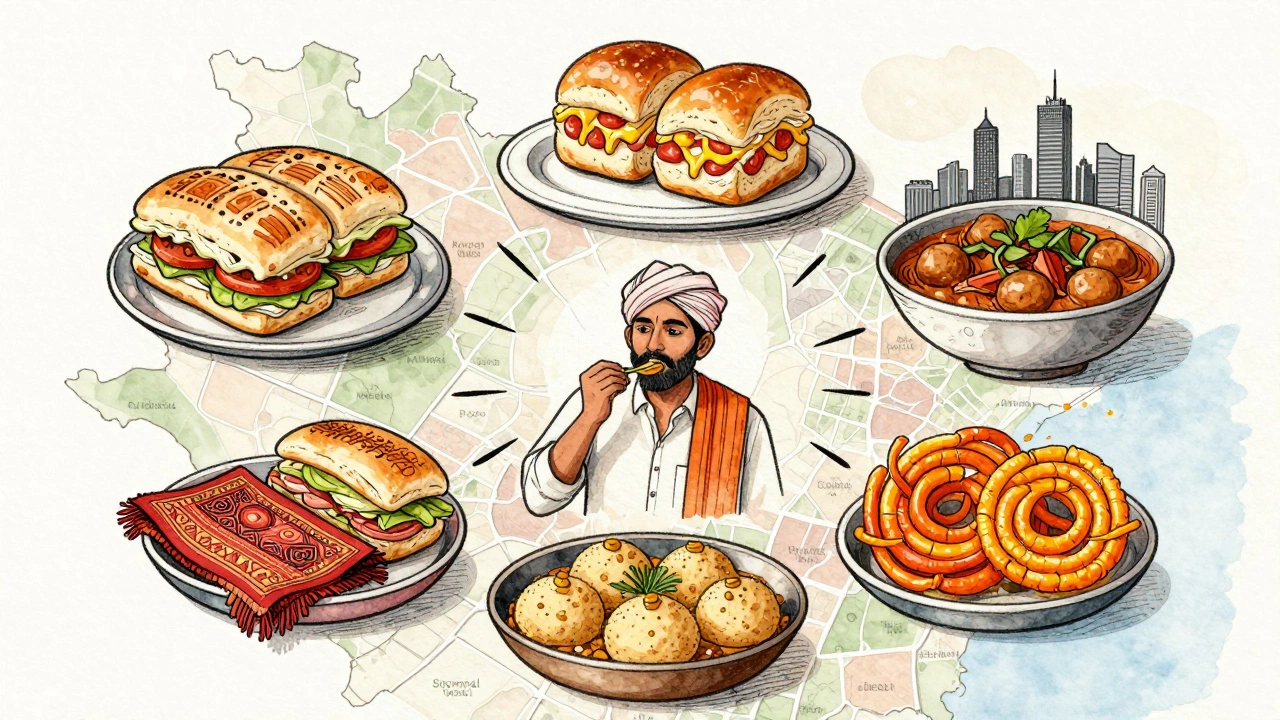
Hyderabad and Lucknow: The Royal Contenders
Hyderabad’s biryani is legendary, and yes, you can get it from a cart. But street food here is mostly centered around haleem during Ramadan or mirchi bajji at Charminar. The city has a strong food culture, but it’s not as pervasive. You’ll find fewer stalls per square kilometer than in Mumbai.
Lucknow, on the other hand, is all about kebabs. The galawati kebab, shami kebab, and seekh kebab are sold in tiny shops tucked behind mosques and old havelis. But these are specialty items. You won’t find a 24-hour chaat stall here. The city’s street food is elegant, slow, and tied to specific occasions.
Why Mumbai Wins-By the Numbers
Let’s break it down:
| City | Estimated Licensed Vendors | Daily Dishes Offered | 24/7 Availability | Food Diversity Score (1-10) |
|---|---|---|---|---|
| Mumbai | 8,700+ | 5,000+ | Yes | 9.7 |
| Delhi | 5,200 | 3,100 | Partial | 8.2 |
| Kolkata | 4,100 | 2,800 | No | 8.5 |
| Hyderabad | 3,400 | 2,200 | No | 7.1 |
| Chennai | 2,900 | 1,900 | Partial | 7.8 |
Mumbai scores highest on diversity because it combines regional styles from Gujarat, Maharashtra, Karnataka, and even Pakistan. You can eat a Punjabi paratha at 7 a.m., a Goan fish curry at noon, and a Bengali mishti doi at 11 p.m.-all within a 20-minute auto ride.
What Makes a City a Street Food Powerhouse?
It’s not just about how many stalls there are. It’s about:
- Accessibility-Can you get food at 3 a.m. after a night out? Mumbai says yes.
- Consistency-Does the same vendor serve the same taste for decades? Mumbai’s best stalls have been run by the same families since the 1950s.
- Cultural integration-Is street food part of daily life for everyone? In Mumbai, office workers, taxi drivers, and college students all eat the same vada pav.
- Adaptability-Can the food scene survive monsoons, heatwaves, and economic shifts? Mumbai’s vendors have moved carts, switched fuels, and adapted menus for over 80 years.
Delhi has the heritage. Kolkata has the soul. But Mumbai has the scale, the stamina, and the sheer madness of it all.
Where to Eat If You Only Have One Day
If you’re visiting Mumbai and want the full street food experience in 24 hours:
- 7 a.m. - Vada pav at Ashok Vada Pav in Dadar (the original, no frills, crispy potato fritter in a soft bun).
- 11 a.m. - Pav bhaji at Sardar Pavilion in Colaba (smoky, buttery, served with raw onions and lemon).
- 3 p.m. - Pani puri at Kailash Parbat in Juhu (the water is tangy, spicy, and sweet-perfect balance).
- 7 p.m. - Sev puri and bhel puri at a stall near Marine Drive (try the one with crushed sev and tamarind chutney).
- 11 p.m. - Misal pav at a roadside stall in Sion (spicy sprouted lentils with bread, topped with farsan).
No restaurant needed. No reservations. Just your hunger and a willingness to stand in line.
Final Verdict: Mumbai Is the Answer
Other cities have iconic dishes. But only Mumbai has the density, diversity, and devotion to make street food its heartbeat. It’s not just the most-Mumbai is the most alive. Walk any street here after sunset, and you’ll smell cumin, frying oil, and tamarind. You’ll hear the clatter of steel plates, the shout of "Pani puri!" and the laughter of strangers sharing one plate.
If you want to taste India’s soul, go where the food never sleeps. Go to Mumbai.
Is Mumbai’s street food safe to eat?
Yes-if you pick wisely. Stick to stalls with long lines, high turnover, and clean utensils. Avoid food that’s been sitting out for hours. Look for vendors who use fresh ingredients daily and wear gloves or tongs. Mumbai’s best stalls have been serving the same customers for decades-they don’t risk their reputation. Avoid ice in drinks unless you’re sure it’s made from filtered water.
What’s the cheapest street food in Mumbai?
Vada pav is the king of affordability. You can get one for ₹25-35 (about $0.30-$0.40 USD). Bhel puri and sev puri cost around ₹30-40. Even a full meal of misal pav with chutney and bread won’t set you back more than ₹60. You can eat like a local for under ₹100 ($1.20 USD) per meal.
Which city has the best pani puri?
Mumbai’s version is the most popular, but Kolkata’s phuchka is equally loved. Mumbai’s pani puri has a sharper, tangier water with a hint of mint and tamarind. Kolkata’s is sweeter, with a thicker potato filling. Both are excellent. But Mumbai’s version is more widely available and often served with extra toppings like sev and chopped onions.
Are there vegetarian street food options in Mumbai?
Absolutely. Over 80% of Mumbai’s street food is vegetarian. Vada pav, pav bhaji, bhel puri, sev puri, misal pav, dahi bhalla, and jalebi are all plant-based. Even the popular "chicken" rolls are often made with spiced tofu or paneer. Non-vegetarian options exist, but they’re the exception, not the rule.
When is the best time to try street food in Mumbai?
Evenings, between 5 p.m. and 10 p.m., are ideal. That’s when the stalls are busiest, the food is freshest, and the atmosphere is electric. Morning street food is also great-try vada pav or poha for breakfast. Avoid midday heat if you’re sensitive to spice or humidity. Nighttime is perfect for dessert-jalebi and falooda are best after dark.