Indian Meal Builder
Build Your Balanced Indian Meal
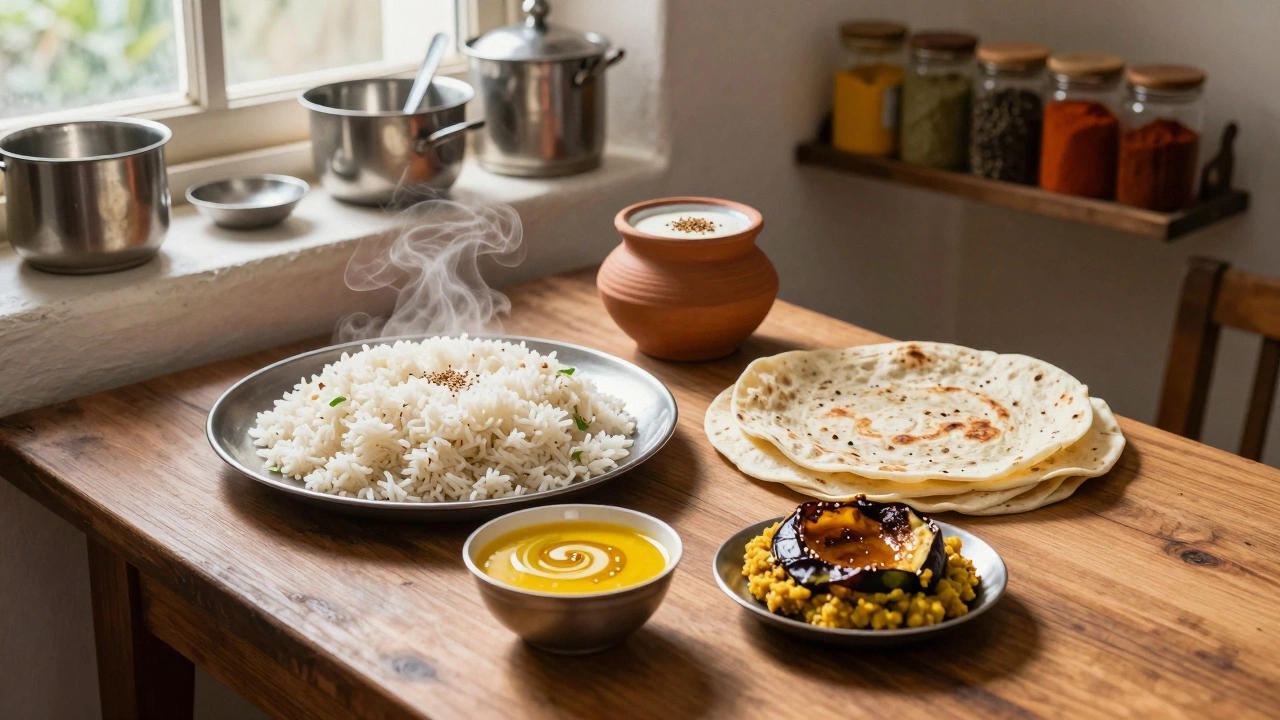
Following the traditional Indian meal structure: one grain, one lentil, one vegetable. Select options to create your authentic home-cooked meal.
When people ask what a normal Indian dish is, they’re often thinking of curry-heavy meals served in restaurants. But that’s not what most Indians eat on a regular day. The truth? A normal Indian dish is simple, seasonal, and shaped by where you live, what’s in your kitchen, and what your family has always made. It’s not about spice levels or fancy techniques-it’s about comfort, balance, and routine.
What Most Indian Families Actually Eat
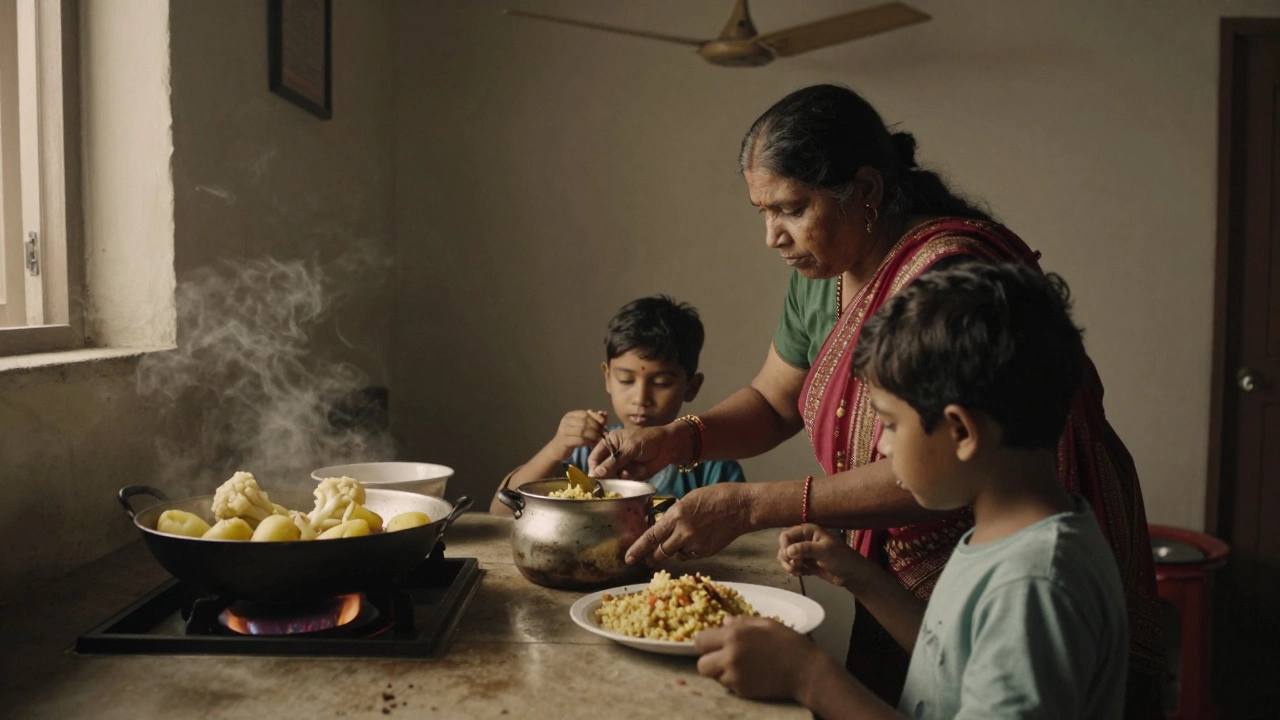
Imagine waking up in a small town in Uttar Pradesh or a suburb in Chennai. Breakfast isn’t dosa or idli every day. More often, it’s plain roti with leftover dal from last night, or poha (flattened rice) cooked with turmeric, peanuts, and a squeeze of lemon. Lunch? Rice with a single curry-maybe baingan bharta (roasted eggplant mashed with tomatoes and spices) or aloo gobi (potatoes and cauliflower fried with cumin and coriander). Dinner might be the same, or just khichdi-rice and lentils cooked together with ginger and cumin, served with yogurt.
These aren’t restaurant dishes. They’re the meals that show up on the table because they’re cheap, filling, and use ingredients you already have. No fancy spices. No 12-step process. Just heat, stir, and serve.
The Myth of the "Curry"
Outside India, "curry" is used like a catch-all word. But in Indian homes, there’s no such thing as "curry." There’s saag, rasam, sambar, kadhi, dal tadka. Each one is distinct. Dal tadka, for example, isn’t a thick, creamy sauce. It’s just yellow lentils boiled until soft, then splashed with hot oil, cumin seeds, garlic, and dried red chilies. That’s it. That’s the normal dish.
Most Indian households make one lentil dish every day. Why? Lentils are cheap, protein-rich, and store well. In rural areas, families might eat the same dal for five days straight, changing only the tempering. In cities, it might be paired with rice, roti, or both. But it’s always there.
Regional Differences Are Real
What’s normal in Punjab isn’t normal in Kerala. In the north, makki di roti (corn flatbread) with sarson ka saag (mustard greens) is a winter staple. In the south, rasam-a tangy tamarind broth with pepper, garlic, and curry leaves-is drunk like soup, not just eaten with rice. In the east, shorshe ilish (hilsa fish in mustard sauce) is a weekend treat. In the west, undhiyu (a mixed vegetable stew with fenugreek and jaggery) is served during festivals.
But here’s the common thread: every region has its own version of rice + lentils + one vegetable dish. That’s the baseline. The rest is variation.
What You Won’t See in a Normal Indian Kitchen
You won’t find:
- Chicken tikka masala on a Tuesday night
- Paneer butter masala as a daily meal
- Five different curries on the same plate
- Spices bought in fancy jars labeled "garam masala"-most families grind their own
- Restaurant-style garnishes like cilantro, cream, or saffron
Those are for guests. For daily meals? It’s about efficiency. Leftovers get reused. Spices are used sparingly. Meals are built around what’s fresh, cheap, and easy.
Why These Dishes Work
Normal Indian dishes follow three rules:
- One grain, one lentil, one veg-that’s the core. Rice or roti, dal or khichdi, and one cooked vegetable. That’s enough.
- Use what you have-If carrots are on sale, you make gajar ka halwa. If cabbage is wilting, you fry it with mustard seeds. Waste is rare.
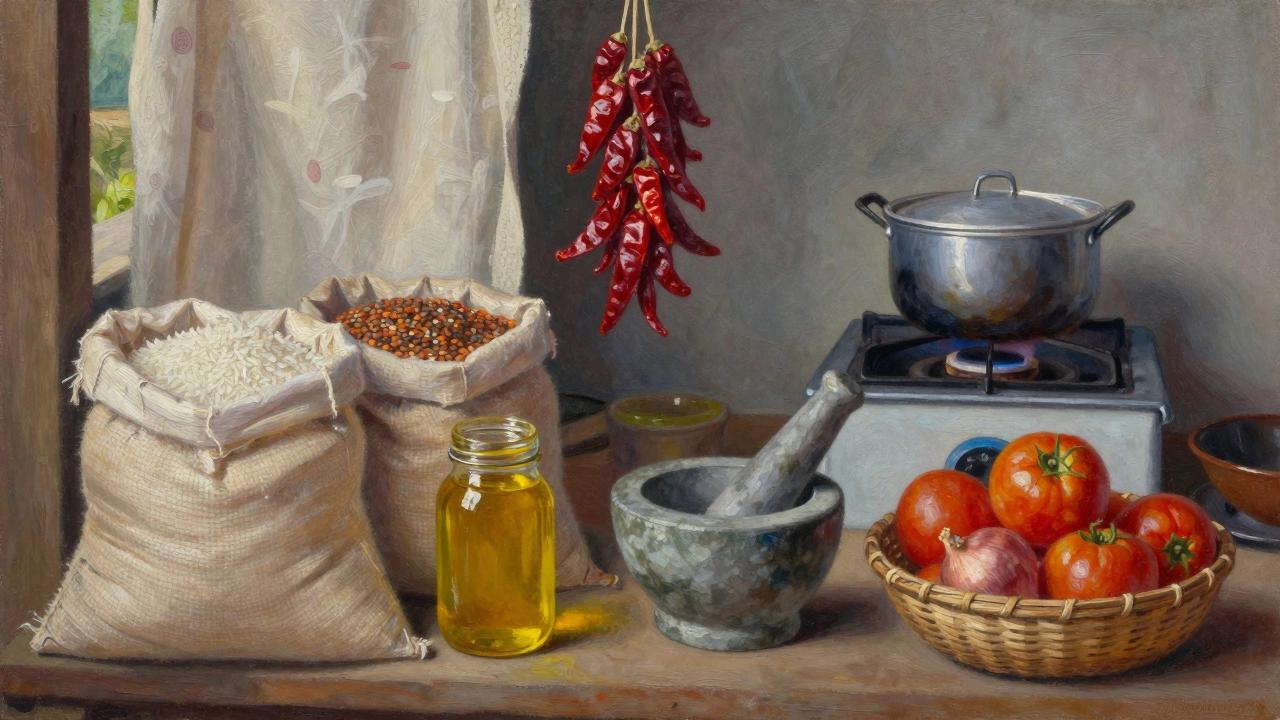
- Spice smart-You don’t need ten spices. Cumin, coriander, turmeric, chili powder, and asafoetida cover 90% of home cooking. The rest? Optional.
Take chana masala. In restaurants, it’s loaded with cream and sugar. At home? Chickpeas boiled with onions, tomatoes, and a pinch of garam masala. Served cold the next day. That’s normal.
What to Try If You Want to Cook Like an Indian Family
Start here:
- Dal tadka-Lentils + oil + cumin + garlic. Takes 30 minutes.
- Simple rice-Just rice, water, salt. No fancy tricks.
- Aloo sabzi-Potatoes, onions, turmeric, cumin. Cooked in 20 minutes.
- Plain roti-Flour, water, salt. Rolled by hand. Cooked on a dry pan.
- Yogurt with roasted cumin-Not sweet. Just plain yogurt, salt, and a pinch of roasted cumin powder.
That’s your menu. No need for coconut milk, cashews, or ghee unless you want it. The real magic is in repetition, not complexity.
What Makes It "Indian"?
It’s not the spices. It’s the rhythm. Indian home cooking is cyclical. You eat the same thing for a week, then switch. You cook once and eat twice. You use leftovers as the base for tomorrow’s meal. You don’t need a recipe book-you need a kitchen that works with the seasons and your schedule.
A normal Indian dish isn’t about impressing anyone. It’s about feeding your family, using what’s available, and making food that doesn’t require a full-time cook. That’s why it lasts. That’s why it’s everywhere.
Common Misconceptions
Many think Indian food is always spicy. But in most homes, "spicy" means "has chili," not "burns your mouth." The heat is mild, adjusted for kids and elders. It’s not about intensity-it’s about flavor.
Another myth? Indian food is vegetarian. While many families are vegetarian, meat is common in coastal areas, the northeast, and Muslim communities. But even then, it’s rarely the star. A small piece of chicken in a curry, or a few pieces of goat in a stew-enough to flavor, not dominate.
And no, you don’t need a tandoor oven. Most Indian homes cook on a gas stove or electric coil. The tandoor is for festivals, not Tuesdays.
Is there one dish that’s the most common across India?
Yes-dal and rice. It’s eaten daily in nearly every household, from Kashmir to Kanyakumari. The type of lentil changes-toor dal in the south, masoor dal in the north-but the combination stays the same. It’s the foundation of the Indian plate.
Why don’t Indians eat curry every day?
Because "curry" isn’t a real dish in India. What people call curry is usually just one vegetable or lentil preparation, cooked simply. Most families rotate between three or four dishes a week. They don’t need variety because each one is satisfying on its own. Plus, cooking multiple complex dishes every day isn’t practical for working households.
Can I make normal Indian food without special ingredients?
Absolutely. You only need: rice or flour for roti, lentils (like red or yellow dal), onions, tomatoes, turmeric, cumin, coriander, chili powder, salt, and oil. Everything else-garam masala, asafoetida, mustard seeds-is optional. Start with these five, and you’ll be 80% there.
Are Indian meals healthy?
Traditional home meals are balanced: carbs from rice or roti, protein from lentils, fiber from vegetables, and fats from minimal oil. Yogurt and pickles add probiotics and flavor without sugar. The problem isn’t the food-it’s the restaurant versions, which add cream, butter, and sugar to appeal to global tastes.
Why do Indian meals often include yogurt?
Yogurt cools the digestive system after spicy or heavy meals. It’s also a probiotic, helps with digestion, and adds protein. In many homes, it’s served plain with a sprinkle of roasted cumin or sugar, depending on the meal. It’s not a side dish-it’s part of the balance.
Final Thought
A normal Indian dish isn’t something you find on a travel blog. It’s the meal your neighbor makes after a long day, using ingredients from the market that morning. It’s not perfect. It’s not Instagrammable. But it’s real. And that’s why it’s lasted thousands of years.